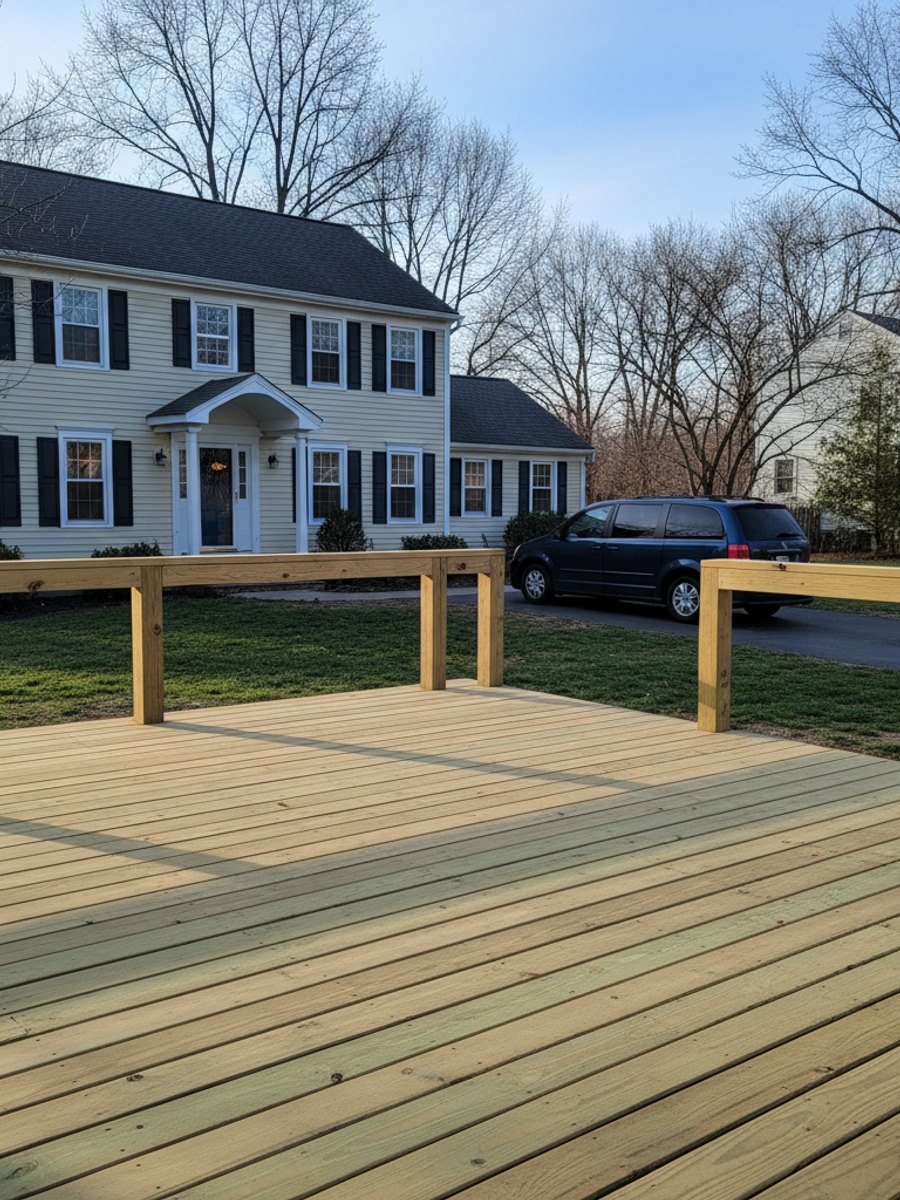
Endicott sits on old Susquehanna River floodplain and glacial till, which means a lot of clay close to the surface once you get past the topsoil. Clay holds water, and water that sits under a footing freezes and expands. That's the whole reason deck footings around here have to go down roughly 42 inches, below the frost line for Broome County. A builder who tells you an 18-inch footing is fine because "that's what the last guy did" is telling you they either don't know the frost depth or don't care. Either one should end the conversation.
This post isn't about picking a specific type of deck. It's about the questions that matter no matter what you're building, a small ground-level platform, a full second-story deck off a kitchen slider, a screened-in porch. The trade has the same failure points across all of it: footings, ledger attachment, framing, and whoever's supposed to be checking the work along the way.
Why the ground here decides how the deck gets built
A lot of Endicott's housing stock dates back to the Endicott-Johnson shoe company era, so you've got streets full of 1910s-1940s bungalows with additions bolted on in the 60s and 70s. That matters for two reasons. First, older rim joists and sill plates weren't always built to hold a deck ledger, and some have already taken on moisture damage that isn't visible until someone pulls the siding back. Second, a lot of these lots have fill soil from when the yard was regraded decades ago, not original clay, and fill settles unevenly. A concrete tube footing poured into fill without hitting undisturbed soil or bedrock will shift over a few winters. You'll see it as a deck that starts to slope toward one corner, usually within 3 to 5 years.
Freeze-thaw is the other piece. Broome County gets somewhere around 35 to 40 freeze-thaw cycles in a normal winter, not one long freeze but repeated freezing and thawing through December into March. Every cycle that hits an undersized or shallow footing pushes it a little. That's frost heave, and it's the single most common structural complaint on older decks in this area. A builder who pours footings correctly the first time is saving you a rebuild in five years, not just following a rule for its own sake.
What the permit process here actually involves
If you're in the Village of Endicott or the surrounding Town of Union, most decks attached to the house or built more than 30 inches above grade need a building permit, and that height also triggers a guardrail requirement, typically 36 inches, with baluster spacing that won't let a 4-inch sphere pass through. A permitted job usually gets at least two inspections: one after the footings are dug and before you pour concrete, and a final once framing and railings are up. Skipping the footing inspection is the one that costs homeowners money later, because nobody can prove what's actually holding the deck up once it's backfilled.
Some lots near the river or in older platted neighborhoods also need a setback check, since older surveys don't always match current lot lines. A contractor who pulls the permit themselves and schedules those inspections is doing what's normal here. One who says permits "aren't worth the hassle" or offers to build it without one to save time is asking you to take on liability that should be theirs.
Questions that separate a real bid from a guess
- What's the footing depth, and is it based on Broome County's frost line or just habit?
- Is the ledger board through-bolted and flashed, or just lag-screwed to the siding? Flashing keeps water from running behind the ledger and rotting the house's rim joist, which is one of the most common reasons decks fail structurally, not from the deck itself but from the house side rotting out underneath the attachment.
- What lumber grade and hardware are being used? Pressure-treated #2 southern yellow pine is standard for framing, but the joist hangers and fasteners need to be rated for that treated lumber's chemical makeup, usually hot-dip galvanized or stainless. Regular zinc-coated screws corrode inside a few years and nobody notices until a board comes loose.
- Who's pulling the permit, and are they scheduling the footing inspection before backfill?
- What's the payment schedule? A deposit up front is normal. Being asked for the full amount before any work starts is not.
A contractor who answers these without hesitation has built decks in this ground before. One who gets vague or annoyed at the questions is telling you something too.
What to walk away from
Cash-only pricing with no written contract is the biggest one. If there's a disagreement later about what was promised, you have nothing to point to. A bid that comes in noticeably lower than two or three others usually means something's being skipped, most often footing depth, ledger flashing, or lumber grade, since those are the parts a homeowner can't see once the decking's down.
No proof of insurance is a hard stop. If a worker falls off a ladder on your property and the contractor isn't insured, that liability can land on you as the homeowner. Ask for a certificate, not just a verbal "yeah, we're covered."
Also watch for anyone who wants to build without a permit "because it goes faster." It does go faster. It also means there's no third-party check on the footings or the railing height, and if you ever sell the house, an unpermitted deck can hold up the sale or force you to tear it out.
What a fair contract looks like
A solid proposal names the footing depth and spacing, the framing lumber species and grade, the fastener type, whether the ledger will be flashed, the railing height and baluster spacing, and who's responsible for the permit. It has a payment schedule tied to milestones, not one lump sum up front. And it gives you a rough timeline, since a straightforward ground-level deck might take a crew 3 to 5 days start to finish, while a raised deck with a permit process and inspections built in can run closer to two or three weeks depending on how backed up the Village inspector's schedule is.
None of this is complicated once you know what to ask. Most homeowners just haven't had a reason to learn it before now. If you want to talk through what a specific lot or an older ledger attachment would need before you get quotes, that's the kind of thing we walk people through as part of our deck builder work around Endicott and the surrounding towns.